
First Knowledge Prepared Environment

Montessori Curriculum for Infant & Toddler to Early Childhood

Curriculum

Implementation

Assessment

Research

First Knowledge

Prepared Environment  

Early Childhood Montessori Curriculum
Ages 3-6, when children build concentration, order, and independence through their own work.

The Early Childhood curriculum covers all seven areas of the prepared environment: Sensorial, Practical Life, Math, Language Arts, Geography and History, Botany, and Zoology. Every presentation is sequenced from concrete to abstract and written out step by step, so teachers know what to show, what to say, and what comes next for each child.

 Aligned to Early Learning Standards
 Step-by-Step Presentations & Roadmap 
 Observation & Record Keeping  
What's Included?

Teaching Manuals

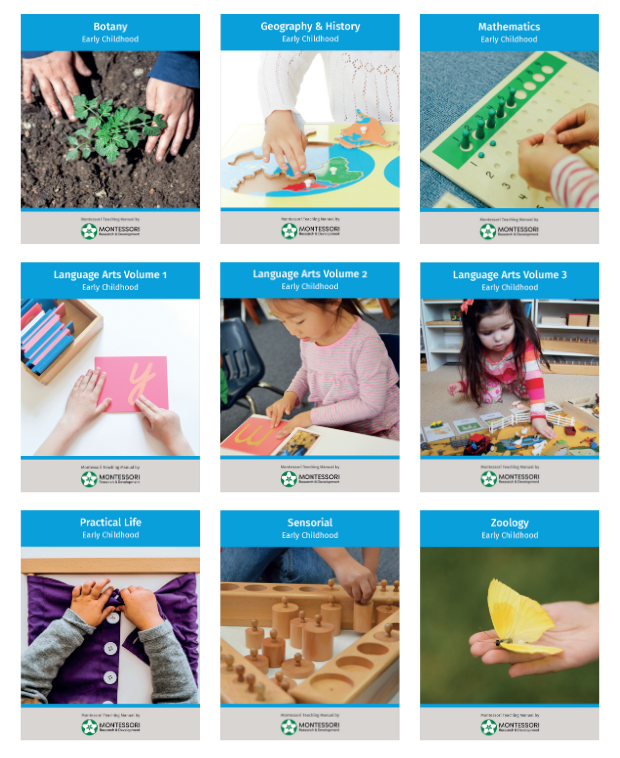
Nine manuals covering every area of the Early Childhood curriculum. Each presentation is written out step by step with clear illustrations, so a teacher can prepare a lesson before giving it.

  • Practical Life
  • Sensorial
  • Mathematics
  • Language Arts Vol. 1
  • Language Arts Vol. 2
  • Language Arts Vol. 3
  • Geography and History
  • Botany
  • Zoology
Card Materials

More than sixty sets of printed card materials that put each presentation into the child's hands.

Language Arts and Literacy is the largest area, moving from initial sound pictures through phonic three-part cards, consonant blends, phonogram cards, and word lists. Sensorial extends the classic apparatus with pattern cards, matrices, and matching work for the cylinders and geometric solids. Geography and History covers continents, land and water forms, flags, and time. Botany and Zoology follow with nomenclature and concept development sets.

All cards are printed on 100lb cover stock and laminated front and back at 3mil.

Classic Montessori Materials

Every apparatus a three to six classroom needs, included in the package.

The Pink Tower, Brown Stair, Red Rods, and Cylinder Blocks. The Geometry Cabinet and Constructive Triangles. Golden Beads, Number Rods, Bead Chains, and the full arithmetic sequence. Sandpaper Letters, the Movable Alphabet, and Metal Insets. Puzzle maps, globes, and land and water forms. Practical Life implements, care of the environment materials, and dressing frames.

Order one package and open a complete prepared environment.

Skills the Child Builds Here

Every material in the First Knowledge Prepared Environment has a purpose, a sequence, and a built in way for the child to find their own errors. Nothing is taught in isolation, and no skill arrives on a schedule. These are the skills that grow across the three year early childhood cycle.

Concentration

Coordination and Control

Independence

Choosing work and staying with it
The child is not asked to sit still and attend to something chosen for them. The work is interesting enough to hold attention on its own, and the period is long enough to return to it as many times as the child wishes.
In the Classroom
A child transfers beans from one bowl to the next, then transfers them back. Another grades the Pink Cubes, takes the tower apart, and builds it again. The work is finished when the tray is back on the shelf.
Directing the hand with intention
Each presentation is broken into slowed, isolated steps so the child absorbs a clear image of the movement. The hand progresses from whole hand grasp to three finger grasp to refined finger
 work.
In the Classroom
A child clips clothespins to a line, twists a nut onto a bolt, cuts a strip of paper. At the Dressing Frames another works a zipper, then a buckle, then a bow. On the Line, a child carries a small bell and tries not to let it ring.
Doing it oneself, and knowing how
Materials sit on open shelves at the child's height, and the child selects, works, and restores without asking permission. Competence in caring for the body comes first an
d carries into academic work.
In the Classroom
A child slices a banana, eats it at the snack table, then washes the plate and sets it in the rack. Another fastens a coat alone, sleeve by sleeve. A third notices a spill nobody mentioned and goes to get the cloth.

Order and Sequencing

Sensory Discrimination

Problem Solving

A beginning and an end
The young child has a deep need for order, and the prepared environment answers it. External order becomes internal organization, which is the earliest form of executive function.
In the Classroom
A child sorts buttons by color into two small baskets. Another maps the hand, then the body, then the classroom, then the community. A third arranges photographs of their own life from birth to this year.
Noticing what is actually there
Each Sensorial material isolates a single quality so the child can perceive it clearly. The child then receives the exact word for what they have already noticed.

In the Classroom
A child fits ten cylinders into ten holes, one of them twice. Another pairs Sound Cylinders by listening, shaking each one twice before deciding. Nearby a teacher gives three words for what a hand already knows: thick, thicker, thickest.
Finding the error and continuing
Every material carries a control of error built into its design. The child discovers the mistake from the material rather than from an adult, so correction becomes information instead of failure.
In the Classroom
A thick cylinder will not enter a thin hole, so the child tries the next one along. A tower with one cube out of order simply looks wrong. A word label beside the wrong picture sends the child back to sound it out.

Spoken Language

Writing and Reading

Mathematical Thinking

Naming the world precisely
Rich vocabulary runs through every area of the curriculum, not only the language shelf. The child learns real names for real things, and uses them.
In the Classroom
A four year old names the pericarp of a fruit and the pistil of a flower. Another finds the isthmus on the globe and traces it with a finger. In a Grace and Courtesy lesson, a child practices interrupting politely before needing to.
Sound to symbol to sentence
The child builds words before reading them, and encodes before decoding. Four color coded series carry the sequence: Pink, Lilac, Blue, and Green.
In the Classroom
A child traces a Sandpaper Letter with two fingers and says its sound. Another lays out the Moveable Alphabet beside a small pig and builds p, i, g. A third reads a word list with no pictures to help, then looks up.
Quantity before symbol, always
Every abstraction is preceded by something the child has held in both hands. Quantity and symbol are met separately, then joined.
In the Classroom
A child counts the Number Rods and carries the longest one with both arms. Another lays counters beneath numerals and finds some numbers pair evenly and some do not. A third lifts the thousand cube and discovers what a thousand weighs.

Scientific Inquiry

Geographic Understanding

Social and Emotional Skills

Caring first, then asking why
Botany and Zoology begin with responsibility rather than information. The child tends a plant and an animal, and the questions follow from the tending.
In the Classroom
A child waters the plants each morning and notices which one has drooped. Another puzzles the parts of the fish and names the dorsal fin. At the window two children check the weather and change the calendar card.
Knowing where one is
Geography begins with the child's own hand and expands outward to the earth. The globe is met through touch before the map is met through the eye.
In the Classroom
A child runs a finger over rough continents and smooth oceans on the sandpaper globe. Another cuts brown paper and lays it on blue to make an island, then a lake. A third finds North in the play yard, then finds it again indoors.
Living well alongside others
Grace and Courtesy is taught explicitly, not merely expected. The child is shown how to greet, wait, ask, decline, and apologize, then practices each one.
In the Classroom
A child walks around a rug on the floor rather than across it. In the Silence Game the room goes quiet, and a child hears their own name whispered across it. A five year old shows a three year old how to carry a tray.

First Knowledge Prepared Environment

Boost your confidence, master the field, become a certified professional. Learn to use all the related tools, walk into a job and be a rockstar from day one. The skills you need to become a real professional and thrive in your career.

Live Creative Sessions


Methodology & Rationale


First Knowledge Prepared Environment

Empty space, drag to resize